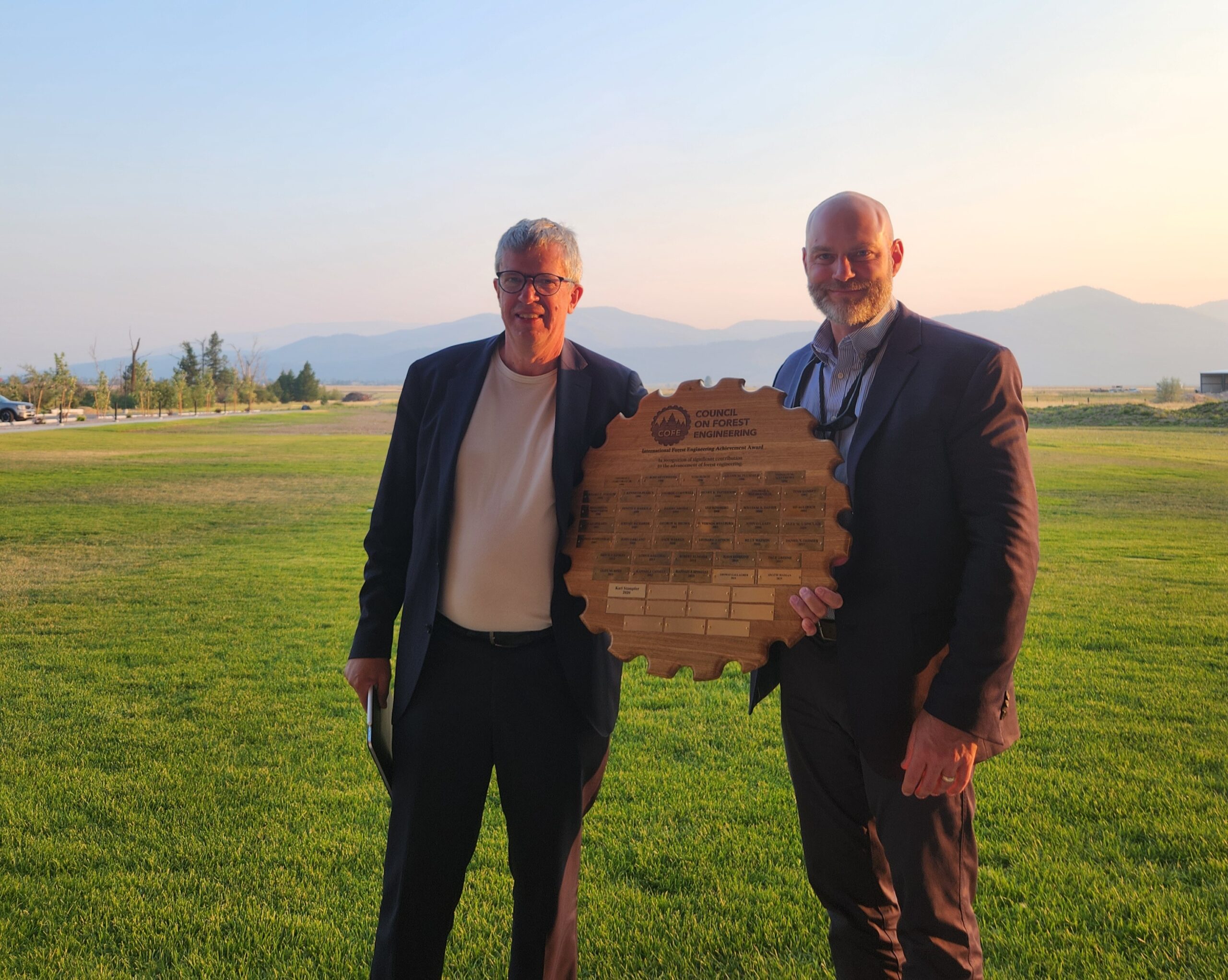
Prof. Dr. Karl Stampfer of BOKU University in Vienna, Austria, is a globally recognized leader in forest engineering, celebrated for his research in steep-terrain harvesting, his transformation of FORMEC into a premier international forest engineering conference, and his three-decade commitment to mentoring and industry collaboration.
Prof. Stampfer earned his master's degree (Dipl.-Ing.) in Forest Science from BOKU University in 1991, followed by a Ph.D. in Natural Resources and Life Sciences in 1996 and his habilitation in Forest Engineering in 2002. He joined BOKU's Institute of Forest Engineering as a research assistant in 1991, rising through faculty ranks to become Assistant Professor in 2002, Head of the Institute of Forest Engineering in 2004, and Full Professor of Forest Engineering in 2012. He also served as Head of the Department of Forest and Soil Sciences at BOKU from 2007 to 2025 and has held visiting professorships at the University of Canterbury, New Zealand, in 2009 and 2023.
His research spans timber harvesting, cable yarding, forestry work science, ergonomics and safety, bioenergy, road network planning, and — more recently — LiDAR-based forest inventory, sensor-based safety monitoring, and AI-driven "smart forest operations." He has led or co-led numerous major Austrian and EU-funded research projects, including SafeForests, SMARTSKY, TECH4EFFECT, and the ongoing AutoForst initiative. As of May 2026, his publication record includes 96 peer-reviewed papers, over 2,199 citations, and an h-index of 26.
Prof. Stampfer's most distinctive contribution to the international forest engineering community has been his leadership of FORMEC, the Forest Engineering Network, as its President. Colleagues credit him with transforming FORMEC from a regional Central European event into one of the world's two leading forest engineering conferences, alongside COFE, while deliberately positioning it as a partner rather than a competitor to COFE. Under his leadership, joint COFE-FORMEC meetings have become a hallmark of transatlantic collaboration, and he has consistently supported North American participation in FORMEC and Austrian delegations at COFE.
He is an active member of several IUFRO research groups, including Forest Operations Under Mountainous Conditions, Ergonomics, and Small-Scale Forestry, as well as a longtime COFE member. His standing in industry is reflected in his service on the program committee for INTERFORST, a major European forestry trade show, and his frequent role as an expert in forestry litigation.
Over his career, Prof. Stampfer has advised more than 100 Ph.D. and master's students, many of whom now hold leadership positions across academia, government, and industry throughout Europe. Colleagues describe him as having built one of the strongest forest engineering research teams in Europe, notable not only for its scientific output but for his ability to mentor, retain, and elevate early-career researchers rather than overshadow them.
Prof. Stampfer's collaborations extend across New Zealand, Norway, Sweden, Croatia, Romania, Italy, Switzerland, Japan, the United States, and Canada, reflecting both the breadth of his scientific network and his role in bridging European and North American forest engineering communities. He also serves as an editor for multiple scientific journals and reviews for numerous others.
Colleagues consistently describe Prof. Stampfer as a congenial, humble, and generous leader whose strong work ethic and genuine investment in others have earned him deep and lasting professional respect. His nomination for the COFE International Forest Engineering Achievement Award reflects a career defined by scientific rigor, sustained mentorship, and an unwavering commitment to strengthening the global forest engineering community.